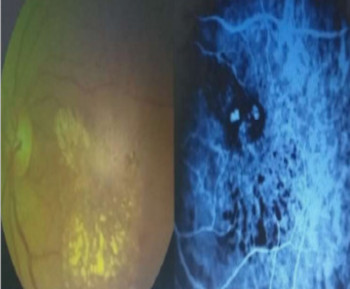
From beautiful nails to sore eyes: a case of ocular super glue injury in Abuja
Abstract
INTRODUCTION
Commercial cyanoacrylate glue (super glue) has gained popularity among young ladies due to its high adhesive ability when used to hold stick-on artificial nails.1–3 Artificial nail fixing accounts for 3.8% of cases of ocular super glue injury.4 Previous cases of ocular super-glue instillation have been reported in Nigeria, in two patients who mistook it for their ophthalmic eye ointment.5,6 Burning sensation and inability to open the eyelids are common symptoms. Ocular findings may include: inadvertent tarsorrhaphy, eyelash loss, bruises along the eyelid margins, conjunctival hyperemia, chemosis, and corneal epithelial defects.5–8 Ocular super glue instillation can be prevented by the use of protective eyewear during use, proper handling and a change in packaging to avoid accidental instillation in place of an eye ointment.1,5 We present a case of ocular super glue injury.
CASE REPORT
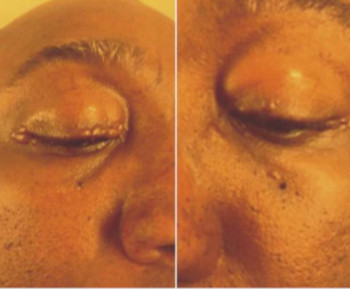
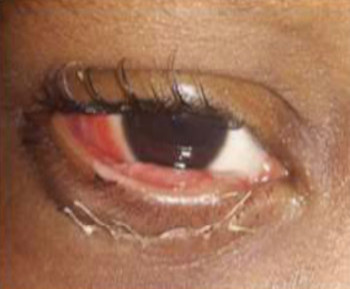
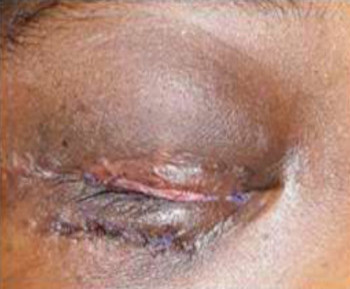
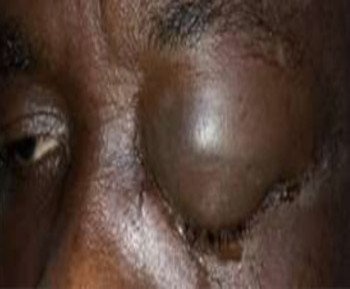
Miss A.E., a 25-year-old lady presented to the hospital’s emergency department on account of inability to open the left eye for 2 hours after super glue accidentally squirted into her left eye while trying to fix nail extensions. She also had tearing, mild eye pain and foreign body sensation in the left eye. Prior attempts to open the eye after irrigation proved abortive. Examination of the left eye showed dried glue residue on the eyelids and eyelashes, chemical tarsorrhaphy involving more than two-thirds of the eyelids, and mild lid margin hyperemia (Figure 1).
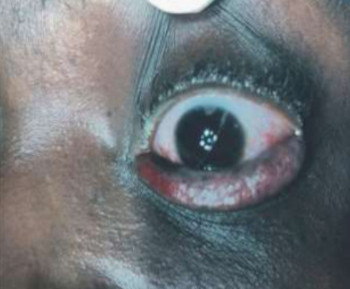
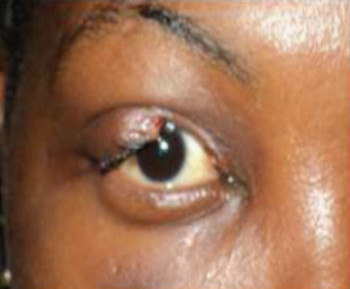
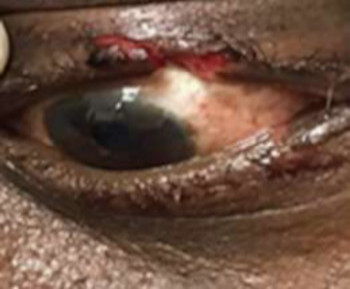
The right eye was essentially normal. Copious irrigation with 1 litre of normal saline was done, amethocaine eye drops were instilled, and KY-jelly mixed with 0.1mls of lidocaine was applied over the eyelid margin and lashes. Gentle manipulation was done using KY-jelly lubricated cotton buds to open the lids. On further examination, visual acuity was 6/12 on the right and 6/9 on the left. Slit lamp examination showed glue crusts on the ocular surface, which were removed under topical anaesthesia, and corneal abrasions mildly staining with fluorescein (Figure 2).
She was placed on tetracycline ointment and nepafenac eye drops.She was commenced on steroid ointment after 48 hours, and this was used for 10days. An artificial tear gel was used for another 2 weeks. At 6 weeks post-injury, visual acuity was 6/6 BE, and she also had a refraction with BCVA of 6/5 in both eyes. The patient’s informed consent was obtained for the clinical photographs and this case report.
DISCUSSION
Cosmetic-related cyanoacrylate glue injuries following nail and eyelash fixing are becoming popular. 2,4,9 Improper handling is a common risk factor in adults.7 Like the index case, other studies have reported chemical tarsorrhaphy and corneal abrasions after these injuries.2,5-7,9 Although thorough irrigation is advised by cyanoacrylate glue manufacturers, the rapid polymerization when in contact with fluid makes this poorly effective. Thorough ocular lubrication, lash trimming, and surgical separation have been used in other studies. 2,5-7,9 Our report describes an effective and low-cost method of managing cyanoacrylate glue-induced chemical tarsorrhaphy by gentle manipulation using a lubricant mixed with a local anaesthetic agent.
CONCLUSION
Accidental splash of superglue into the eyes can occur during nail fixing, and protective eye wear is advised to prevent this. Management consists of copious lubrication, gentle eye opening under topical anaesthesia, and topical steroid/antibiotic ointments. Prompt management results in complete recovery and good visual prognosis.
References
1. Reddy S. Superglue injuries of the eye. Int J Ophthalmol. 2012;5(2):634-637. doi:10.3980/j.issn.2222-3959.2012.05.18
2. Yusuf I, Patel C. A sticky sight: cyanoacrylate ‘superglue’ injuries of the eye. BMJ Case Rep. 2010;2010:bcr11.
3. Terman SM. Treatment of Ocular Super Glue Instillation. J Trauma Inj Infect Crit Care. 2009;66(5):70-71.
4. Tabatabaei A, Modanloo S, Ghiyasvand A, et al. Epidemiological aspects of ocular superglue injuries. Int J Ophthalmol. 2016;9(2):278-281. doi:10.18240/ijo.2016.02.19
5. Cookey S, Chukwuka I, Sibedu O. Rare chemical injuries : a case of ocular superglue instillation in Port Harcourt. Int Med Case Rep J. 2018;11:209-212.
6. Alen H, Akang U, Ameen K, Saba M, Bature M, Ahmed A. Ocular Superglue Injury. Tranasactions Ophthalmol Soc Niger. 2019;4(1):50-51.
7. Malepati N, Sharma S, Kate A, Basu S, Shanbhag SS. Original Article Clinical profile and management of ocular superglue injuries : Case series and review of literature. 2024;(2):1-5. doi:10.4103/IJO.IJO
8. Mathieu A, Coste-Verdier V, Koudsie S, Brisset I, Lanoux C. Iatrogenic cyanoacrylate glue-induced eye injuries in the pediatric population: A national multicenter retrospective descriptive study. J Fr Ophtalmol. 2025;48(5):104466.
9. Samet A, Li D, Al-Qahtani A, Arthurs B, El-Hadad C. Nail glue injuries to the eye: assessment of two cases. Can J Ophthalmol. 2022; 57(1):E11-E13
Additional Files
Published
How to Cite
Issue
Section
Categories
License
Copyright (c) 2025 Transactions of the Ophthalmological Society of Nigeria

This work is licensed under a Creative Commons Attribution-NonCommercial-NoDerivatives 4.0 International License.