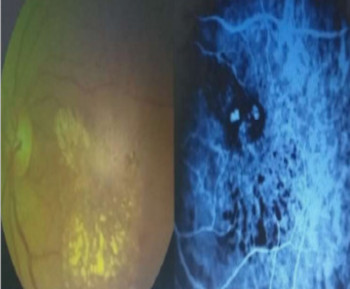
Real World Experience of Intravitreal Faricimab for Retinal Vascular Disease in Ibadan
Abstract
BACKGROUND
Retinal vascular diseases constitute a leading cause of global visual impairment.1 This challenge is amplified in developing countries like Nigeria, where the intersection of increasing diabetes prevalence and limited access to subspecialty retinal care creates a growing unmet medical need.2
Evidence-based treatment guidelines from the American Academy of Ophthalmology have established intravitreal Anti-Vascular Endothelial Growth Factor (Anti-VEGF) agents as the standard of care for centre-involving Diabetic Macular edema with vision loss3, Retinal Vascular Occlusion-related macular edema4, and neovascular Age-related Macular Degeneration5. Nevertheless, the treatment paradigm faces practical limitations due to the frequent injection schedules required by current anti-VEGF monotherapies, resulting in considerable patient and healthcare system burden.
Faricimab (Vabysmo®) introduces a breakthrough bispecific approach by simultaneously targeting Vascular Endothelial Growth Factor-A (VEGF-A) and angiopoietin-2 pathways.6 This dual mechanism reduces vascular permeability and neovascularization while stabilizing blood vessels and decreasing VEGF-A sensitivity, achieving longer treatment intervals than conventional anti-VEGF agents.7-11 Following faricimab's recent introduction in Nigeria, we present our initial real-world experience at University College Hospital, Ibadan.
METHODS
A retrospective case series of patients who received intravitreal faricimab injections for retinal vascular diseases at the Department of Ophthalmology, University College Hospital, Ibadan. Patients’ demographic characteristics, diagnosis, baseline and follow-up best corrected visual acuity (BCVA), optical coherence tomography findings, number of injections, and adverse events were obtained from the patients’ records and analysed. Cases included diabetic macular edema (DME), central retinal vein occlusion with macula edema (CRVO + ME), and choroidal neovascular membrane (CNVM) from wet age-related macular degeneration.
RESULTS
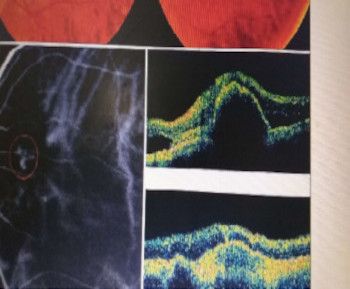
Ten patients were treated with faricimab, including 4 cases of DME, 3 cases of CRVO with macular edema, and 3 cases of wet AMD with CNVM. Their ages ranged from 56 to 79 years. Visual acuity (VA) improvements were observed after the first injection in 8 cases. Notable outcomes included: Case 1 (CRVO) - VA improved from counting fingers to 6/12; Case 2 (CRVO) - VA improved from counting fingers to 6/18; Case 7 (CNVM) - VA improved from 6/60 to 6/12 after switching from bevacizumab; Case 10 (CNVM) - VA improved from 6/36 to 6/12 after failed bevacizumab and aflibercept therapy. Complete resolution of macular edema and subretinal fluid was achieved in 8 cases after the first injection and all cases after the third injection. Two cases (20%) developed sterile intraocular inflammation with elevated intraocular pressure (28-40 mmHg) occurring 1-2 weeks after the third injection, which resolved with topical anti-inflammatory and anti-glaucoma medications.
CONCLUSION
Real-world application of faricimab in Ibadan demonstrates significant therapeutic potential for retinal vascular diseases, with patients achieving rapid visual and anatomical improvements. Careful surveillance for inflammatory responses remains essential, particularly after the second injection. Region-specific randomized controlled trials are needed to establish evidence-based treatment algorithms for our population.
References
1. Hariprasad SM, Holz FG, Asche CV, et al. Clinical and Socioeconomic Burden of Retinal Diseases: Can Biosimilars Add Value? A Narrative Review. Ophthalmol Ther. 2025;14(4):621-641.
2. Piyasena MMPN, Murthy GVS, Yip JL, et al. Systematic review on barriers and enablers for access to diabetic retinopathy screening services in different income settings. PLoS One. 2019;14(4):e0198979.
3. Lim JI, Kim SJ, Bailey ST, et al. Diabetic Retinopathy Preferred Practice Pattern®. Ophthalmology. 2025;132(4):P75-P162.
4. Pulido JS, Flaxel CJ, Adelman RA, Hyman L, Folk JC, Olsen TW. Retinal vein occlusions preferred practice pattern® guidelines. Ophthalmology. 2016;123(1):P182-P208.
5. Vemulakonda GA, Bailey ST, Kim SJ, et al. Age-Related Macular Degeneration Preferred Practice Pattern®. Ophthalmology. 2025;132(4):P1-P74.
6. Nicolò M, Ferro Desideri L, Vagge A, Traverso CE. Faricimab: an investigational agent targeting the Tie-2/angiopoietin pathway and VEGF-A for the treatment of retinal diseases. Expert opinion on investigational drugs. 2021;30(3):193-200.
7. Tadayoni R, Paris LP, Danzig CJ, et al. Efficacy and Safety of Faricimab for Macular Edema due to Retinal Vein Occlusion: 24-Week Results from the BALATON and COMINO Trials. Ophthalmology. 2024;131(8):950-960.
8. Heier JS, Khanani AM, Quezada Ruiz C, et al. Efficacy, durability, and safety of intravitreal faricimab up to every 16 weeks for neovascular age-related macular degeneration (TENAYA and LUCERNE): two randomised, double-masked, phase 3, non-inferiority trials. The Lancet. 2022;399(10326):729-740.
9. Wykoff CC, Abreu F, Adamis AP, et al. Efficacy, durability, and safety of intravitreal faricimab with extended dosing up to every 16 weeks in patients with diabetic macular oedema (YOSEMITE and RHINE): two randomised, double-masked, phase 3 trials. The Lancet. 2022;399(10326):741-755.
10. Sahni J, Patel SS, Dugel PU, et al. Simultaneous inhibition of angiopoietin-2 and vascular endothelial growth factor-A with faricimab in diabetic macular edema: BOULEVARD phase 2 randomized trial. Ophthalmology. 2019;126(8):1155-1170.
11. Khanani AM, Patel SS, Ferrone PJ, et al. Efficacy of every four monthly and quarterly dosing of faricimab vs ranibizumab in neovascular age-related macular degeneration: the STAIRWAY phase 2 randomized clinical trial. JAMA ophthalmology. 2020;138(9):964-972.
Additional Files
Published
How to Cite
Issue
Section
Categories
License
Copyright (c) 2025 Transactions of the Ophthalmological Society of Nigeria

This work is licensed under a Creative Commons Attribution-NonCommercial-NoDerivatives 4.0 International License.