Case report on recurrent Retinoblastoma
Abstract
INTRODUCTION
Retinoblastoma is the commonest childhood ocular malignancy, accounting for about 2.5 to 4 % of all paediatric malignancies.1,2 The disease is a life-threatening cancer though good survival rates have been reported especially in advanced countries, where detection is early with good care.3 The challenges of management in low- and middle-income countries are late presentation and paucity of trained manpower for cancer care.3 However, cases of recurrence have been recorded despite optimal care.2,3 The purpose of this case report is to highlight the need for vigilance, lifelong follow up and optimal care, with a high index of suspicion for recurrence.
CASE PRESENTATION
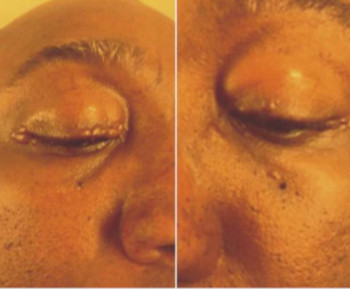
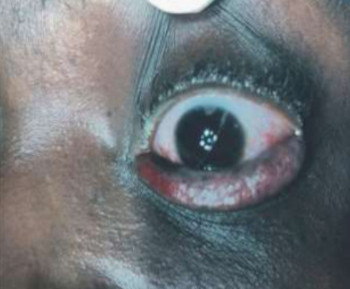
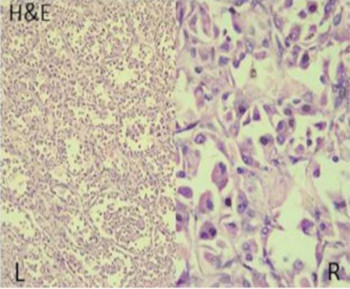
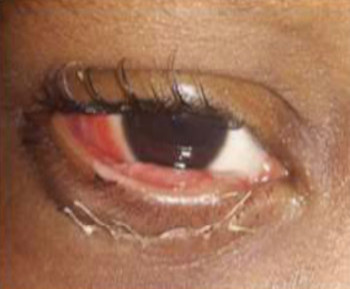
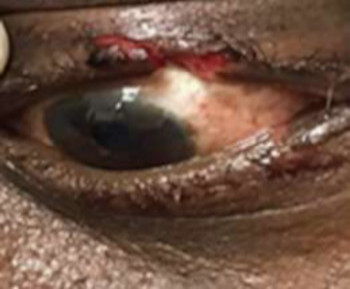
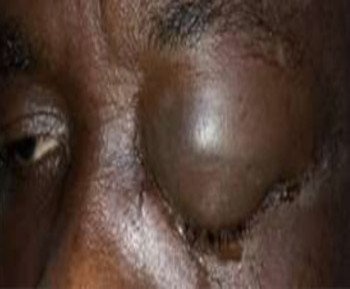
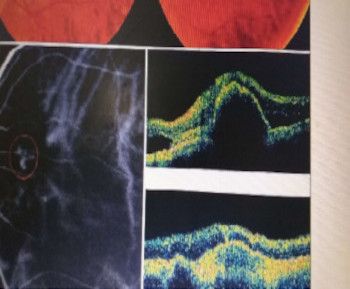
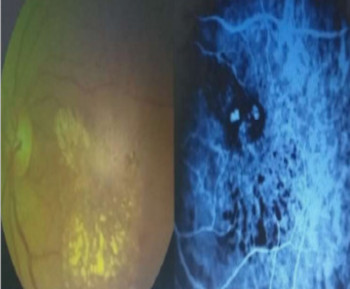
A 10-year-old boy, born in Zaria, Nigeria, first presented on 12/08/2016 after his mother noticed a whitish speck in his right Eye (RE) at 18 months of age. Examination revealed a healthy-looking child with stable vital signs. Visual acuity was uncentral, unsteady and unmaintained fixation on the right eye and central, steady and maintained fixation on the left eye. There was a whitish mass filling the whole of the vitreous of the RE. Examination under anesthesia (EUA) done on 30/08/2016 showed tumour in the left eye (LE). A diagnosis of bilateral retinoblastoma: RE group E and LE group C was made. His parents were subsequently counselled on their child’s condition. He had right eye (RE) Enucleation with orbital implant. Histology report revealed nuclei hyperchromasia with scanty cytoplasm, and necrotic fleurettes, pathognomonic of Retinoblastoma. The tumor involved the optic nerve stump. He received 15 cycles of high-dose chemotherapy [HDC] (Vincristine, etoposide and carboplatin), at monthly intervals, plus 3 cycles of transpupillary thermotherapy (TTT) in the left eye. EUA done on 11/04/2017 revealed no evidence of disease. He had 6 more cycles of HDC in view of optic nerve involvement. EUA done on 11/01/2018 showed tumour tumour-free status with visual acuity of 6/6 in the LE. He subsequently underwent 6-monthly EUA until late 2021 and continued follow-up in another facility throughout 2022. He presented on 20/02/2023 with complains of deterioration of vision in LE. His visual acuity was 6/18, with a hypopyon like deposit in the anterior chamber (Figure 1). EUA confirmed a tumour recurrence in the LE.
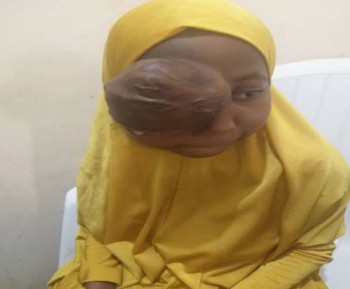
He was reviewed by the Oncologist who recommended administration of 2nd line drugs. He subsequently had 3 doses of intracameral and intravitreal Topotecan, 1 mg. The tumor in the anterior chamber (AC) disappeared after two doses. He subsequently developed cataract for which he had lens washout with foldable intraocular lens (IOL) implant. His current V/A in the LE is 6/36. The most recent magnetic resonance imaging (MRI) done revealed no intracranial involvement. The oncologist plan is to continue with chemotherapy, and also discussed with the national Retinoblastoma Network (RB- NET)who advised on counselling parents for enucleation of the remaining only eye (Figure 2).
DISCUSSION
Reese4 published the first study on RB recurrence in 1948, and estimated an orbital recurrence rate of 72 %. A review of RB recurrence done in 2019 noted that recurrence is usually intraocular with rates ranging from 6 to 45 percent5. In another study, the estimated rate of recurrence was 46% at 3 years and 50% at 5 years.2 Despite the use of many treatment options that salvage the globe and life of children, recurrence rates have been on the increase,2 especially where late presentation, anterior chamber involvement and intracranial spread has occurred.4 Most recurrences occur within 3 years of treatment, though late recurrence that occurred after more than 10 years has been reported4. Following systemic chemoreduction, which was the first-line treatment for this patient, it is estimated that the rate of development of new retinal tumors range from 24 to 44 %.4 For the index patient, recurrence was noticed 6 years after initial diagnosis. It is worthy to note that most studies stated diagnosis and treatment were delayed in about one third of patients 4 which is a common problem in developing countries like Nigeria, mainly because paucity of trained personnel e.g. paediatric ophthalmologists. Patients have to travel across different geopolitical zones to access paediatric cancer care. However, in this index case who presented quite early to one of the best tertiary eye care centers and had the best optimal treatment possible, recurrence still occurred. This underscores the need for strict vigilance and maintaining high index of suspicion for recurrence, so that the correct plan of treatment can be continued with regards to second line and adjuvant treatment. Regular and lifelong follow up of the patient is required to prevent recurrent RB.
CONCLUSION
Retinoblastoma care and treatment remain a challenge in developing countries. Cases of recurrence have been recorded years after successful treatment as in this index patient. Follow-up should be for life despite successful treatment.
References
1. NHS Health Education England. Genomics Education Programme: Retinoblastoma. June 2020. Available from: https://www.genomicseducation.hee.nhs.uk/wp-content/uploads/2019/05/Retinoblastoma-1.pdf
2. Li N, Wang YZ, Zhang Y, Zhang WL, Huang DS. Characteristics of patients with recurrent retinoblastoma : a survival analysis. BMC Cancer [Internet]. 2024;1–7. Available from: https://doi.org/10.1186/s12885-024-12058-3
3. Byroju VV, Nadukkandy AS, Cordani M, Kumar LD. Retinoblastoma : present scenario and future challenges. Cell Commun Signal [Internet]. 2023;1–16. Available from: https://doi.org/10.1186/s12964-023-01223-z
4. Berry J, Kogachi K, Murphree A, Jubran R, Kim J. A Review of Recurrent Retinoblastoma: Children’s Hospital Los Angeles Classification and Treatment Guidelines. Int Ophthalmol Clin. 2019 Mar 1;59:65–75.
5. Wang YZ, Zhang Y, Huang DS, Shi JT, Ma JM, Li B, et al. Clinical characteristics , treatment and prognosis of children with unilateral retinoblastoma and intracranial segment of Retrobulbar optic nerve invasion. BMC Ophthalmol. 2021; 21(1):38.
Additional Files
Published
How to Cite
Issue
Section
Categories
License
Copyright (c) 2025 Transactions of the Ophthalmological Society of Nigeria

This work is licensed under a Creative Commons Attribution-NonCommercial-NoDerivatives 4.0 International License.